


MetaTrader 5 offers a broader market structure than its predecessor, with additional timeframes, more order types, and improved backtesting capabilities.
Traders who want access to forex, stocks, indices, and futures from one platform often choose MT5 for that flexibility.
Broker selection remains critical because pricing models, execution quality, and asset coverage vary widely.
This guide reviews the best MT5 brokers based on platform performance, market depth access, regulation standards, and overall trading conditions.
Best MT5 Brokers
MetaTrader 5 gives you more depth than MT4, including additional order types, expanded timeframes, and access to more asset classes.
The brokers below offer strong MT5 infrastructure, competitive pricing, and solid regulatory backing.
1. Blueberry Markets

Blueberry Markets supports MetaTrader 5 with both Standard and Raw account structures.
Traders can access forex pairs, indices, commodities, and crypto CFDs directly inside the MT5 platform. The broker operates under ASIC regulation and keeps client funds segregated.
MT5 users benefit from depth of market visibility and faster multi-threaded strategy testing compared to older platforms.
Blueberry maintains low-latency connections to liquidity providers for stable pricing during volatile sessions.
- Raw spreads from 0.0 pips with commission
- Support for automated trading via MQL5
- VPS hosting available for continuous execution
The MT5 environment supports hedging, pending orders, and advanced charting tools.
Traders can run algorithmic systems or manual strategies with full control over margin and exposure.
Funding methods include bank transfer, card, and online payment services.
2. IC Markets

IC Markets provides true ECN-style trading through MetaTrader 5 with access to deep institutional liquidity.
Traders can choose Raw Spread or Standard accounts depending on pricing preference. It operates under ASIC and CySEC regulation and offers competitive execution speeds.
MT5 allows traders to access more than 60 currency pairs along with indices, commodities, and bonds.
- Raw spreads starting near 0.0 pips
- Multi-asset trading on one platform
- High-speed execution infrastructure
MT5 users gain depth of market tools and advanced backtesting with multi-currency support. The platform handles automated strategies efficiently through MQL5.
IC Markets hosts servers in major financial centers to reduce latency and maintain price stability during news events.
3. Pepperstone

Pepperstone integrates MetaTrader 5 with Razor and Standard account options.
Razor accounts provide low spreads plus commission, while Standard accounts include spread-only pricing.
The broker operates under ASIC, FCA, and other regulators, which adds oversight and credibility. MT5 users access a broad selection of forex pairs and CFD instruments.
- Support for scalping and algorithmic systems
- Smart Trader Tools compatibility
- Deep liquidity from global providers
Pepperstone enables depth of market display inside MT5 and supports advanced order management.
Traders can deploy Expert Advisors or trade manually with multiple chart windows.
The broker maintains strong server infrastructure designed for consistent pricing and reduced slippage.
4. BlackBull Markets

BlackBull Markets offers MetaTrader 5 with ECN connectivity and tiered account structures. Traders can select Standard, Prime, or Institutional accounts depending on capital size.
The broker operates under New Zealand regulation and provides direct access to global liquidity providers.
MT5 users gain access to forex pairs, commodities, indices, and crypto CFDs.
- ECN pricing with tight spreads
- Support for hedging strategies
- Fast order processing speeds
MT5 enables advanced charting and depth of market analysis.
Traders can deploy automated systems through MQL5 and conduct multi-asset portfolio management within one interface.
BlackBull connects clients to major financial hubs to maintain competitive execution during volatile periods.
5. Fusion Markets
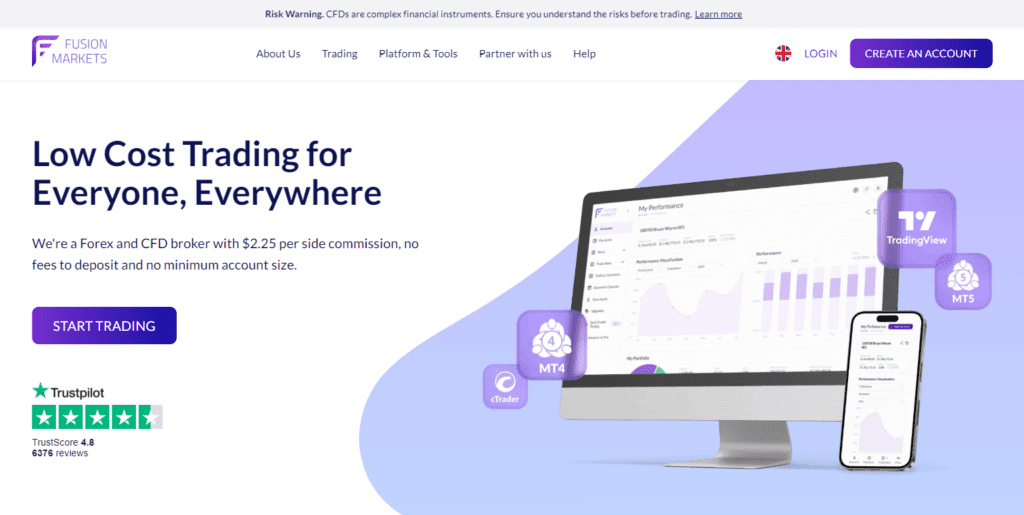
Fusion Markets supports MetaTrader 5 with a focus on low trading costs.
The broker offers competitive commission rates on Raw accounts and spread-based pricing on Classic accounts.
Fusion operates under ASIC regulation and maintains segregated client funds. MT5 users can access forex pairs and CFD markets with transparent pricing.
- Low commission per lot
- Support for automated strategies
- No inactivity fees
MT5 allows traders to use advanced order types and depth of market tools. Fusion Markets maintains reliable execution speeds suitable for short-term strategies.
Traders can deploy Expert Advisors and manage positions through desktop or mobile MT5 versions without restriction.
6. Eightcap
Eightcap provides MetaTrader 5 access with Raw and Standard account structures. The broker operates under ASIC and FCA oversight.
MT5 users can trade forex pairs, indices, commodities, and crypto CFDs. Eightcap connects traders to liquidity providers to ensure competitive spreads and stable pricing.
- Competitive Raw account spreads
- Support for algorithmic trading
- Multi-asset CFD access
MT5 includes advanced charting tools, additional timeframes, and integrated economic calendar features.
Eightcap supports automated trading via MQL5 and allows hedging strategies. Traders can manage risk through stop loss and take profit settings directly within the platform.
8. FOREX.com

FOREX.com offers MetaTrader 5 alongside its proprietary trading platform. The broker operates under multiple regulators including the CFTC and FCA.
MT5 users gain access to a broad range of forex pairs and CFD instruments. The broker provides transparent pricing and institutional-grade liquidity.
- Strong regulatory oversight
- Wide currency pair coverage
- Integrated market research tools
MT5 allows traders to use advanced order types and detailed chart analysis. FOREX.com supports automated systems and provides depth of market visibility.
The broker maintains strong financial backing and offers comprehensive educational resources for active traders.
9. FxPro
FxPro supports MetaTrader 5 with competitive pricing and access to multiple asset classes.
The broker operates under FCA and CySEC regulation and maintains segregated client accounts. MT5 users can trade forex, indices, commodities, and shares through CFD contracts.
- Multiple regulatory licenses
- Fast execution with no dealing desk
- Advanced charting environment
FxPro provides depth of market tools and supports algorithmic trading through MQL5. Traders can choose between different account types depending on pricing preference.
The broker maintains robust infrastructure to support both discretionary and automated strategies.
| Broker | Regulation Tier | Account Types on MT5 | Standout MT5 Strength |
| Blueberry Markets | Tier-1 (ASIC) | Standard, Raw | Depth of Market + VPS support |
| IC Markets | Tier-1 (ASIC, CySEC) | Standard, Raw Spread | True ECN liquidity access |
| Pepperstone | Tier-1 (ASIC, FCA) | Standard, Razor | Advanced order execution tools |
| BlackBull Markets | Tier-2 (FMA NZ) | Standard, Prime, Institutional | Tiered ECN structure |
| Fusion Markets | Tier-1 (ASIC) | Classic, Raw | Low commission model |
| Eightcap | Tier-1 (ASIC, FCA) | Standard, Raw | Crypto + Forex access on MT5 |
| FOREX.com | Tier-1 (CFTC, FCA) | Standard | Integrated research tools |
| FxPro | Tier-1 (FCA, CySEC) | Variable, Raw-style | No dealing desk execution |
| FXTM | Multi-region regulation | Micro, Advantage, Advantage Plus | Flexible account sizing |
MT4 vs MT5: What Actually Changes in Real Trading
MT4 and MT5 look similar at first glance, but their internal structure and capabilities differ in ways that affect execution, testing, and asset access.
- Execution Engine
MT5 uses a multi-threaded architecture, which allows faster processing and improved stability under heavy load. MT4 runs on a single-threaded system. In normal conditions both perform well, but MT5 handles complex strategies and larger data sets more efficiently. - Strategy Testing Power
MT5 includes a multi-currency strategy tester with faster optimization tools. Traders can test portfolios and run parallel simulations. MT4 supports backtesting, but it processes one currency pair at a time with fewer optimization options. - Market Depth and Order Handling
MT5 provides built-in Depth of Market visibility and supports both hedging and netting systems. MT4 supports hedging but does not include full exchange-style order book features. - Asset Expansion
MT5 was designed to support more than forex. Brokers use it to offer stocks, futures, bonds, and commodities alongside currencies. MT4 remains primarily focused on forex and CFD trading. - Platform Complexity
MT5 includes more timeframes, additional order types, and an integrated economic calendar. This makes it more powerful but slightly more complex for beginners. MT4 remains simpler and easier to learn for new traders.
Traders who rely heavily on automation and multi-asset access often choose MT5. Forex-only traders who value simplicity still prefer MT4.
Frequently Asked Questions
Is MT5 Better Than MT4 for Forex Trading?
MT5 offers more tools, faster strategy testing, and additional order types.
However, many forex traders still prefer MT4 because of its simplicity and large ecosystem of existing Expert Advisors.
The better platform depends on your trading style, automation needs, and whether you plan to trade assets beyond currency pairs.
Can You Use MT4 Indicators on MT5?
No. MT4 indicators use MQL4, while MT5 uses MQL5. The coding structure differs, so indicators and Expert Advisors require conversion or redevelopment.
Many developers offer MT5 versions of popular tools, but direct installation without modification does not work.
Does MT5 Execute Trades Faster Than MT4?
MT5 uses a more advanced multi-threaded system, which improves processing efficiency.
Actual trade execution speed depends mainly on your broker’s server infrastructure and liquidity providers.
The platform architecture supports faster internal processing, but broker quality remains the key factor.
Is MT5 Harder to Learn for Beginners?
MT5 includes more features and order types, which can make the interface feel more complex at first.
Basic trading functions such as placing market or pending orders remain straightforward. With practice, beginners can adapt quickly to the additional tools.